
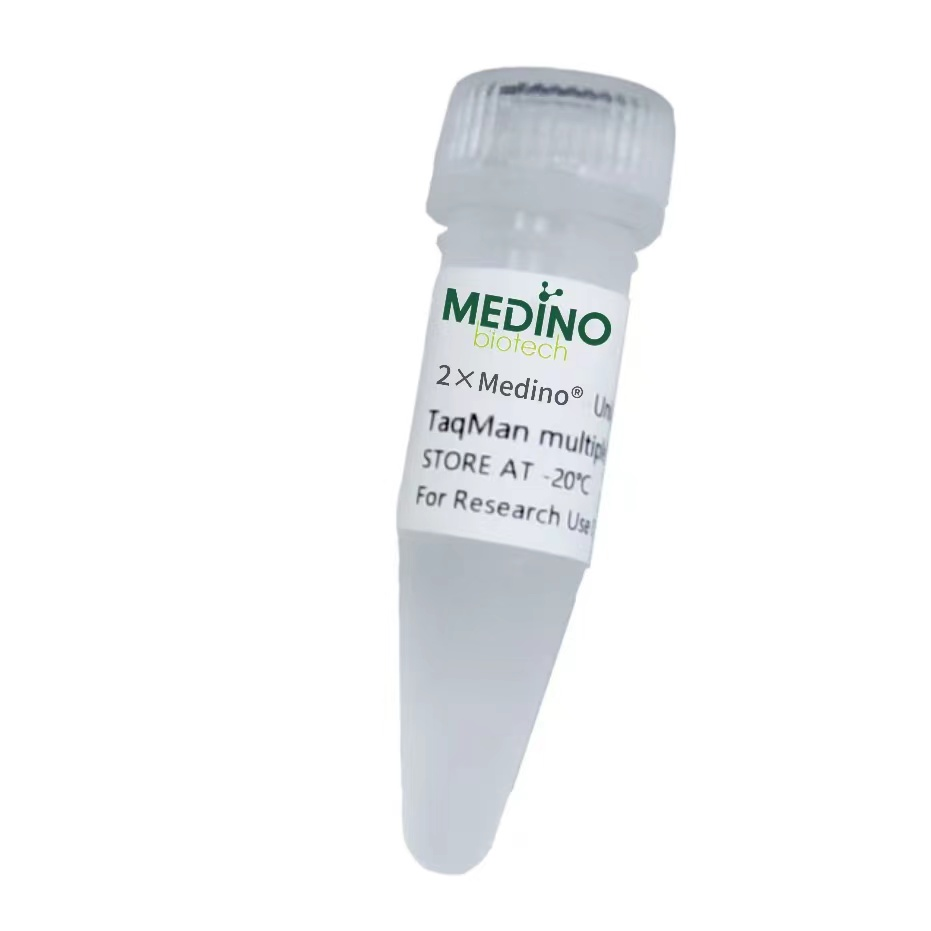
qNTQX® Universal Multiplex qPCR Master Mix (Probe Based)
A blue-coloured 2× probe-based qPCR master mix supporting up to four targets per reaction. Antibody-mediated hot-start Taq and a visual sample-addition indicator support multiplex assay setup.
2× ready-to-use mix
Blue visual indicator
Antibody hot-start Taq
RUO
Product overview
Medino® Universal Multiplex qPCR Master Mix (Probe Based), catalog no. LM602002, is a 2× premix for real-time amplification of DNA or separately prepared cDNA. The blue formulation includes a visual sample-addition indicator. Genetically modified, antibody-mediated hot-start Taq and an optimised multi-target buffer support multiplex quantitative analysis and genotyping. Add target-specific primers, probes, template and water. ROX reference dye is not included.
Four targets in one well
Supports up to four fluorescent qPCR targets in a single reaction. Validate primers, probes and channel compatibility for each panel.
Visual setup aid
The blue-coloured formulation provides a visual sample-addition indicator.
Antibody-mediated hot start
Modified Taq polymerase and an optimised buffer are designed to support sensitive, specific amplification, including low-concentration templates.
Specifications
| Parameter | Value |
|---|---|
| Format | 2× liquid master mix |
| Detection | Probe-based multiplex qPCR |
| Template | DNA or separately prepared cDNA |
| Multiplex capacity | Up to four targets per reaction |
| Polymerase | Genetically modified, antibody-mediated hot-start Taq |
| Visual indicator | Blue-coloured sample-addition indicator |
| ROX reference dye | Not included; add if required by the instrument |
| Reaction volumes | 25, 30 or 50 µL |
| Mix per 25 µL reaction | 12.5 µL |
| Primer / probe concentration | 0.1–0.5 µM / 50–250 nM final |
| Storage / shelf life | −25 to −15°C / 2 years |
| Intended use | Research use only |
Pack sizes & ordering
| Catalog No. | Pack size | Total mix volume |
|---|---|---|
| LM602002ES01 | 1 mL | 1 mL |
| LM602002ES02 | 5 × 1 mL | 5 mL |
| LM602002ES03 | 5 mL | 5 mL |
| LM602002ES04 | 20 mL | 20 mL |
| LM602002ES05 | 100 × 1 mL | 100 mL |
| LM602002ES06 | 100 mL | 100 mL |
Specify the required pack size when ordering. Source: LM602002 Universal Multiplex qPCR Master Mix (Probe Based) handbook, p. 2.
Performance & validation
The handbook describes amplification of up to four DNA targets per well, with antibody-mediated hot-start Taq and an optimised buffer intended to improve sensitivity and specificity, including for low-concentration templates. It provides no numerical limit of detection, amplification-efficiency or linearity dataset. Source: LM602002 handbook, pp. 2–4.
Up to four-plex
Designed for simultaneous probe-based detection of four targets in one reaction well.
Low-template amplification
The multi-target buffer is designed to promote amplification of low-concentration templates; no numerical detection limit is reported.
Genotyping and quantification
Suitable for genotyping and multiplex quantitative analysis with validated assay-specific primers and probes.
Product documents
Product FAQs
Add target-specific primers, fluorescent probes, DNA or cDNA template and water. Use 12.5 µL of 2× mix in a 25 µL reaction. Up to four fluorescent targets per well. Validate the multiplex panel and detection channels. No. Add ROX only when required by the instrument. The handbook lists 0.4 µL per 25 µL reaction to reach 1×; confirm the ROX stock concentration before use. No reverse-transcription step is provided. Convert RNA to cDNA separately or choose a one-step RT-qPCR kit. It provides a visual sample-addition indicator during reaction setup, not an amplification result readout. 95°C for 5 min, then 45 cycles of 95°C for 15 s and 60°C for 30 s. Adjust annealing conditions and fluorescence acquisition to the assay and instrument. Store at −25 to −15°C. The stated shelf life is 2 years. No. It is for scientific research use only, not diagnostic or clinical procedures.What do I add to the master mix?
How many targets can be detected?
Is ROX included?
Can RNA be used directly?
What is the blue colour for?
What cycling programme is recommended?
How should the product be stored?
Is the product for diagnostic use?