
Product overview
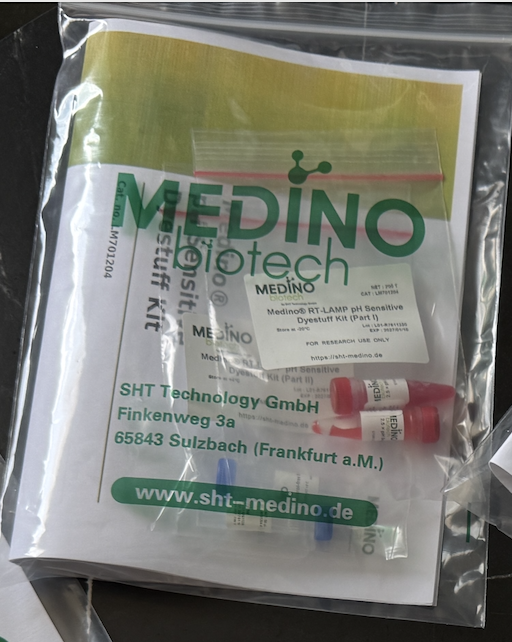
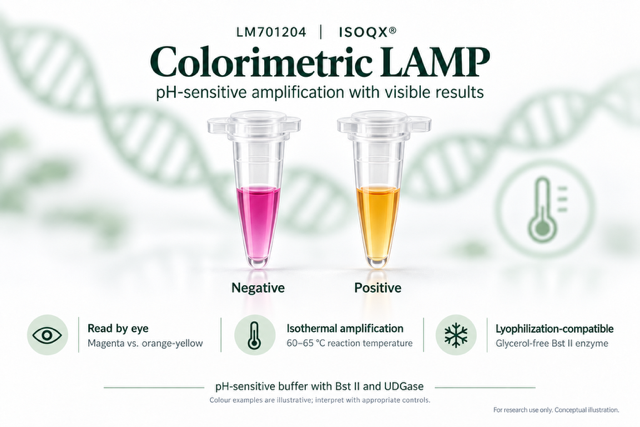
ISOQX® LAMP pH Sensitive Dyestuff Kit (LM701204). A pH-sensitive indicator is integrated into the amplification buffer for visible endpoint detection. The kit includes glycerol-free Bst II DNA Polymerase and UDGase and supports preparation of lyophilized reaction systems. Amplification is performed at 60–65°C with target-specific LAMP primers. Read results after cooling under good lighting, using suitable positive and negative controls.
Visible color contrast
Positive reactions are orange-yellow; negative reactions are magenta under the specified conditions.
Isothermal workflow
The reference amplification step is 30 minutes at 60–65°C; low-template samples may require longer.
Carryover-control chemistry
dUTP and UDGase support degradation of uracil-containing carryover templates before amplification.
Specifications
| Parameter | Value |
|---|---|
| Detection | pH-sensitive colorimetric LAMP |
| Enzyme | Glycerol-free Bst II DNA Polymerase |
| Carryover control | dUTP / UDGase |
| Reaction volume | 25 µL |
| Buffer / enzyme per reaction | 10 µL 2.5× buffer / 0.5 µL enzyme |
| Amplification | 60–65°C for 30 min; low-template samples may need up to 60 min |
| Positive / negative color | Orange-yellow / magenta |
| Buffer storage / shipping | −20°C / dry ice |
| Enzyme storage / shipping | 4°C / ice packs |
| Shelf life | 6 months for both components |
| Intended use | Research use only |
Pack sizes & ordering
| Catalog No. | Tests | Buffer / enzyme |
|---|---|---|
| LM701204ES01 | 100 | 1 mL / 50 µL |
| LM701204ES02 | 1,000 | 10 mL / 500 µL |
| LM701204ES03 | 10,000 | 100 mL / 5 mL |
State the required pack size when ordering. Source: LM701204 handbook, pp. 2–4.
Performance & validation
The handbook describes visible endpoint discrimination between orange-yellow positive reactions and magenta negative reactions. The reference amplification step is 30 minutes at 60–65°C, with longer incubation possible for low template concentrations. No numerical limit of detection or diagnostic accuracy dataset is provided. Source: LM701204 handbook, pp. 2–4.
Read results by eye
A pH-dependent color change provides endpoint detection without a fluorescence reader. Controlled heating is still required.
30-minute amplification step
The reference workflow also includes UDG treatment and enzyme inactivation; 30 minutes is not the total procedure time.
Sample buffer matters
Strong acid/base or highly buffered samples can interfere with the indicator. Follow sample-pH and timing guidance.
Product documents
Product FAQs
A fluorescence reader is not required, but controlled heating is essential. A PCR instrument is strongly recommended in the handbook. No. The workflow also includes pretreatment as needed, UDG treatment, inactivation and cooling. High Tris-HCl concentrations can prevent color change. Follow the handbook guidance on sample pH and buffer capacity. No. It contains components suitable for developing a lyophilized reaction system. No. Store buffer at −20°C and enzyme at 4°C; both have a 6-month shelf life. No. For scientific research use only, not diagnostic or clinical procedures.Do I need an instrument?
Is 30 minutes the total test time?
Can I use a strongly buffered template?
Is it supplied lyophilized?
Are both components stored frozen?
Is this product for diagnostic use?