
Product overview
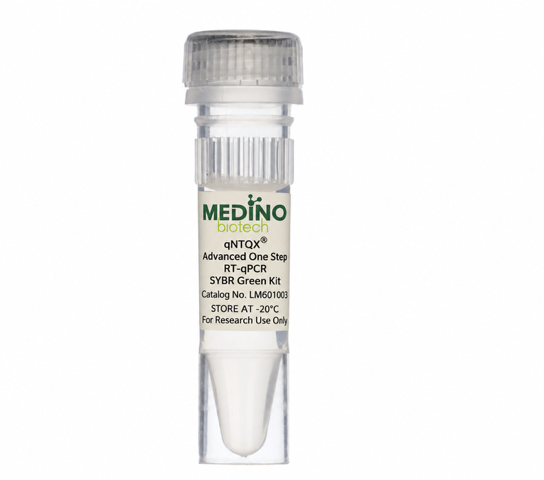
qNTQX® qPCR SYBR Green Master Mix (No Rox) (LM601003). The master mix contains hot-start DNA polymerase, SYBR Green I, dNTPs and Mg²⁺. Add primers, DNA template and water. The formulation is designed to suppress non-specific amplification and supports two-step or three-step cycling followed by melt-curve analysis. For RNA studies, prepare cDNA separately. Use an instrument configuration that does not require ROX passive-reference normalization.
Simple qPCR setup
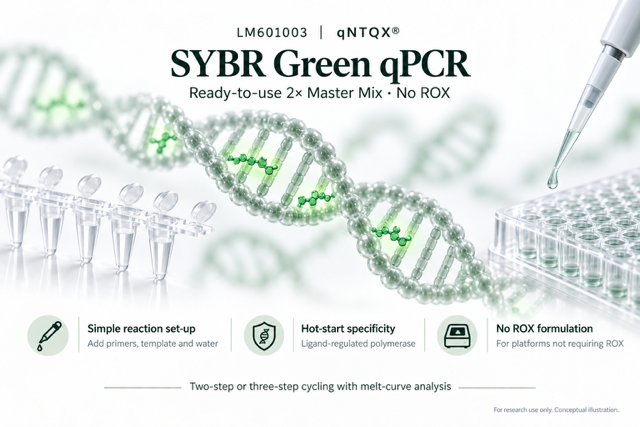
Add primers, template and water to the 2× master mix.
Hot-start specificity
A temperature-responsive ligand controls polymerase activity to limit activity during room-temperature setup.
Melt-curve verification
Two-step and three-step protocols include melt-curve analysis to assess amplification specificity.
Specifications
| Parameter | Value |
|---|---|
| Detection chemistry | SYBR Green I; DNA-binding fluorescent dye |
| Concentration | 2× |
| Template | DNA or separately prepared cDNA |
| ROX reference dye | Not included |
| Reaction volumes | 20 or 50 µL |
| Mix per reaction | 10 µL per 20 µL; 25 µL per 50 µL |
| Typical primer concentration | 0.2 µM each; adjustable 0.1–1.0 µM |
| Platforms (examples) | Bio-Rad CFX96/384; Rotor-Gene Q; LightCycler 480 |
| Storage | −25 to −15°C; protect from light; avoid repeated freeze–thaw |
| Shelf life | 18 months |
| Intended use | Research use only |
Pack sizes & ordering
| Catalog No. | Pack size | Total mix volume |
|---|---|---|
| LM601003ES01 | 5 × 1 mL | 5 mL |
| LM601003ES02 | 100 × 1 mL | 100 mL |
State the required pack size when ordering. Source: LM601003 handbook, pp. 2–4.
Performance & validation
The hot-start formulation is designed to suppress non-specific amplification in SYBR Green qPCR. The handbook provides two-step and three-step protocols and melt-curve interpretation guidance. It does not provide a numerical efficiency or linear dynamic-range validation dataset. Source: LM601003 handbook, pp. 2–4.
Ligand-regulated hot start
Polymerase activity is suppressed at room temperature and enabled during thermal cycling.
Two cycling options
The handbook favors two-step cycling for specificity and three-step cycling for amplification efficiency.
Specificity assessment
Assess amplification and melt curves together. Multiple melt peaks require investigation before quantitative interpretation.
Product documents
Product FAQs
Does this mix require a fluorescent probe?
No. It detects amplification using SYBR Green I and target-specific primers.
Can I use RNA directly?
No. Prepare cDNA in a separate reverse-transcription reaction first.
Is it suitable for every qPCR instrument?
Use platforms that do not require ROX normalization. Select a ROX-containing variant if your instrument requires it.
Why perform a melt curve?
It helps detect primer dimers or non-specific amplification. A single peak supports specificity assessment.
How much mix is needed?
Use 10 µL for a 20 µL reaction or 25 µL for a 50 µL reaction.
Is this product for diagnostic use?
No. For scientific research use only, not diagnostic or clinical procedures.