
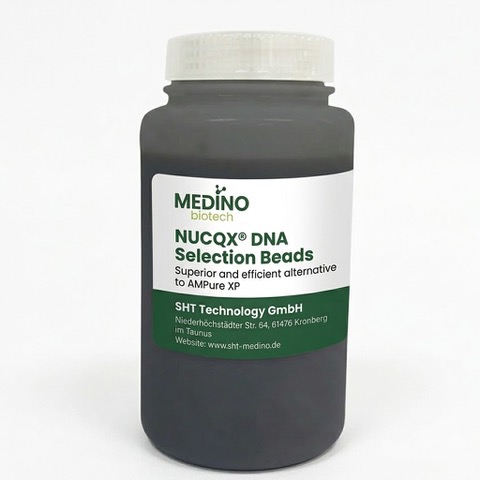
Product overview
SEQQX® DNA Selection Beads, catalog no. LM801002, combine solid phase reverse immobilization (SPRI) with an optimized buffer system for DNA fragment selection and purification during NGS library preparation. The handbook describes compatibility with DNA and RNA library preparation kits from multiple manufacturers and a workflow following the AMPure XP bead protocol. Two successive bead additions enable selection of defined DNA fragment-size ranges.
NGS library preparation
Select and purify DNA fragments within DNA or RNA library preparation workflows.
Adjustable size selection
Six reference ratio pairs target fragment ranges from 250–350 bp to 800–1000 bp.
Magnetic separation
The two-step protocol uses a magnetic stand, two 80% ethanol washes and elution in at least 20 µL of water.
Specifications
| Parameter | Value |
|---|---|
| Technology | SPRI magnetic-bead DNA size selection and purification |
| Method | Two-step selection; magnetic stand required |
| Starting sample volume | At least 100 µL; adjust with ultrapure water if needed |
| Equilibration | At least 30 min at room temperature before use |
| 250–350 bp selection | First-round ratio 0.80×; second-round addition 0.20× |
| 320–420 bp selection | First-round ratio 0.70×; second-round addition 0.20× |
| 450–550 bp selection | First-round ratio 0.60×; second-round addition 0.20× |
| 550–700 bp selection | First-round ratio 0.55×; second-round addition 0.15× |
| 700–900 bp selection | First-round ratio 0.50×; second-round addition 0.15× |
| 800–1000 bp selection | First-round ratio 0.45×; second-round addition 0.15× |
| Ratio basis | Both bead additions are calculated from the original DNA sample volume |
| Washing | Two washes, each 200 µL freshly prepared 80% ethanol for 30 s |
| Elution | At least 20 µL ddH₂O; 5 min at room temperature |
| Storage and shelf life | 2–8°C; 18 months |
| Intended use | Research use only |
Pack sizes & ordering
| Catalog No. | Pack size | Format |
|---|---|---|
| LM801002 | 1 mL | Magnetic-bead suspension |
| LM801002 | 5 mL | Magnetic-bead suspension |
| LM801002 | 10 mL | Magnetic-bead suspension |
| LM801002 | 60 mL | Magnetic-bead suspension |
| LM801002 | 450 mL | Magnetic-bead suspension |
Specify the required volume when ordering. Bead consumption depends on the initial sample volume and the selected ratio pair. Source: LM801002_SEQQX_DNA_Selection_Beads_12601.pdf, pp. 2–4.
Performance & validation
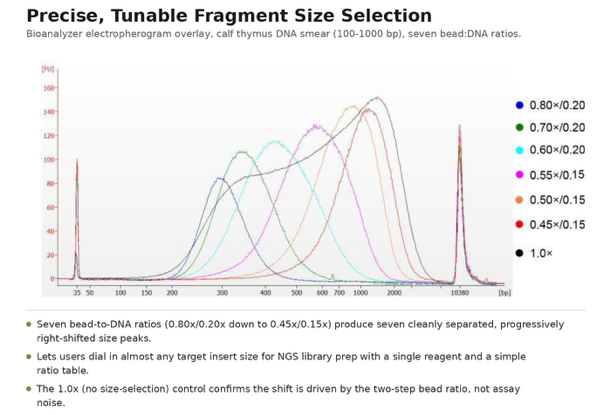
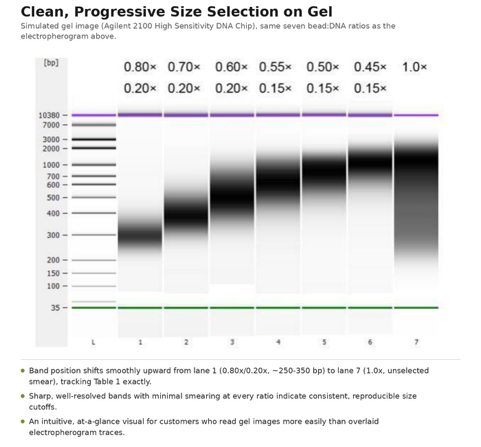
The handbook demonstrates two-step selection using ultrasonicated calf thymus DNA spanning 100–1000 bp, with results assessed by Agilent 2100 Bioanalyzer. It describes recovery and library-size distribution as closely matching AMPure XP beads, without providing a numerical recovery percentage. Source: LM801002 handbook, pp. 2–4.
Six reference size windows
Ratio pairs from 0.80×/0.20× to 0.45×/0.15× correspond to six reference fragment-size ranges.
Electropherogram evidence
Agilent 2100 High Sensitivity DNA Chip analysis is shown for fragmented calf thymus DNA dissolved in water.
Selection conditions
Use at least 100 µL starting DNA solution, equilibrate beads and avoid over-drying to support consistent selection.
Product documents
Product FAQs
How are the bead volumes calculated?
Both additions use the original DNA sample volume. For 100 µL at 0.80×/0.20×, add 80 µL first, then 20 µL to the transferred supernatant.
Which fraction is retained?
Keep the supernatant after the first selection. After the second selection, keep the beads, wash and elute the DNA.
What if the sample is below 100 µL?
Add ultrapure water to at least 100 µL before size selection.
What preparation is required?
Equilibrate beads for at least 30 min at room temperature, mix thoroughly and prepare fresh 80% ethanol. Avoid over-drying after washing.
How should the product be stored?
Store at 2–8°C. Shelf life is 18 months. Research use only.