
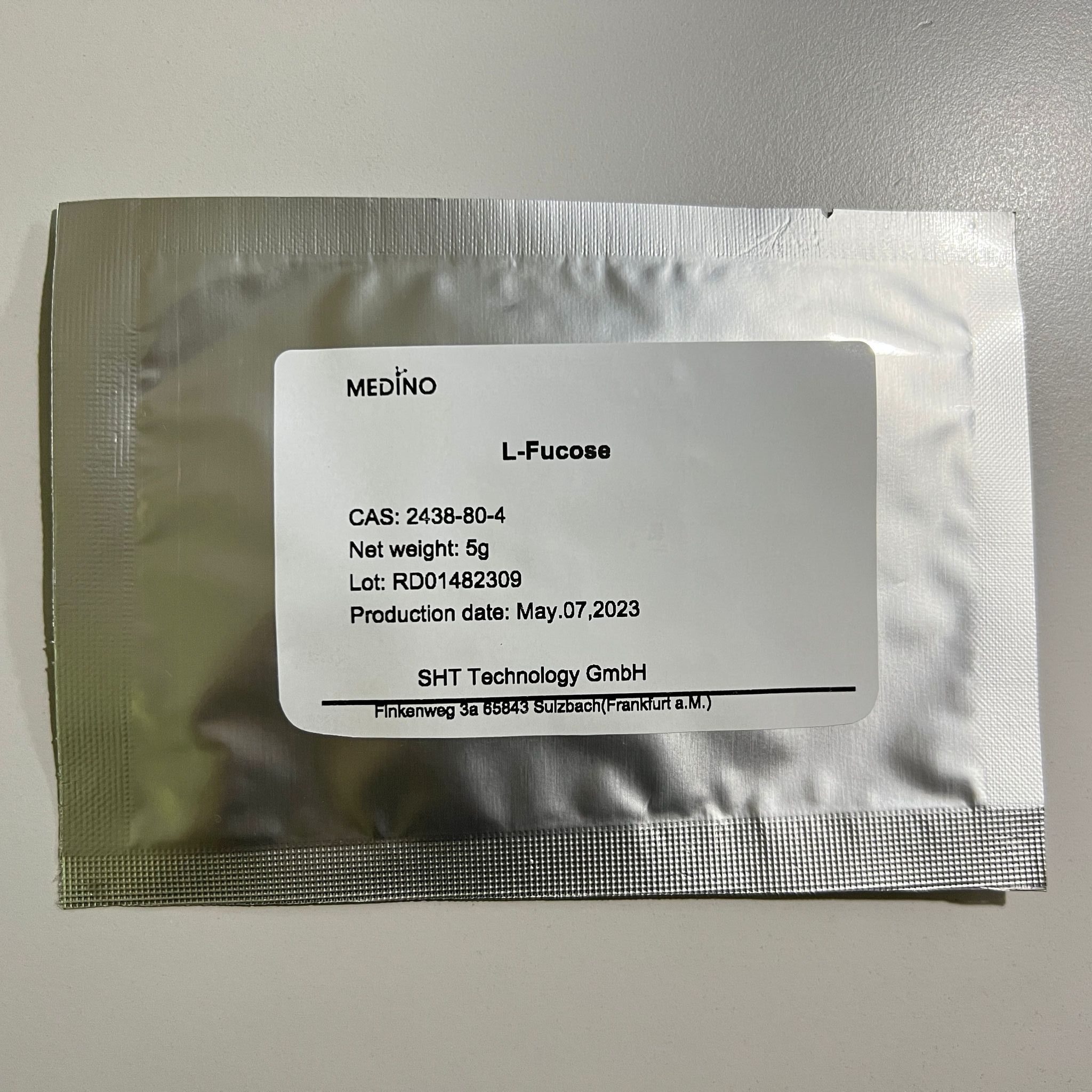
BIOQX® L(-)-Fucose (6-Deoxy-L-galactose)
A rare deoxyhexose monosaccharide with pivotal roles in glycobiology — from blood group antigens to immunological signaling and microbiome interactions. Supplied by an FDA-inspected, GMP-certified manufacturer.
≥ 98% Purity
CAS 2438-80-4
GMP Grade
RUO
Product overview
L-(−)-Fucose (6-Deoxy-L-galactose, CAS 2438-80-4) is a naturally occurring deoxyhexose monosaccharide, lacking the 6-hydroxyl group found in most common sugars.
Present on the outer surface of virtually all mammalian cells, fucose decorates N-linked and O-linked glycoproteins and glycolipids as a terminal or branching modification. This peripheral position makes it a primary recognition signal in a vast array of biological processes central to glycobiology research.
As a leading L-Fucose supplier in Europe, BIOQX® provides pharmaceutical-grade L-Fucose from a GMP-certified, FDA-inspected manufacturing facility, serving research institutes, CROs, and biopharmaceutical companies across Germany and the EU.
Structural uniqueness
The C6-methyl group confers distinct conformational preferences and hydrophobic character absent in other common hexoses.
Metabolic incorporation
Exogenous L-fucose is efficiently salvaged and activated to GDP-fucose, feeding directly into the Golgi fucosylation pathway.
Biosynthetic gateway
Precursor for numerous fucosylated epitopes central to immune recognition, including Lewis antigens and sialyl-Lewis X.
BULK PACKAGING
8 kg drum · Room temp. storage
PRODUCT QUALITY
High-purity white crystalline powder
Fucosylation
Pathway
L-Fucose enters cells via specific transporters and is activated by fucokinase (FUK) and GDP-fucose pyrophosphorylase (FPGT), channeling into the nucleotide-sugar pool as GDP-beta-L-fucose — the universal donor for all cellular fucosyltransferases.
- L-Fucose uptake via plasma membrane transporters
- Phosphorylation to Fucose-1-phosphate (fucokinase)
- Activation to GDP-beta-L-Fucose (FPGT)
- Transfer by alpha-1,3/4/6 fucosyltransferases (FUT1–11)
- Surface glycan display and biological signaling
Specifications
| Property | Value | Notes |
|---|---|---|
| Molecular Formula | C6H12O5 | Deoxyhexose — OH replaced by H at C-6 |
| Molecular Weight | 164.16 g/mol | Confirmed by HRMS |
| CAS Number | 2438-80-4 | L-configuration enantiomer |
| Melting Point | 150–153 °C | Literature value |
| Boiling Point | ~211 °C | Rough estimate |
| Density | 1.1738 g/cm³ | Rough estimate |
| Optical Rotation | [α]D −75° to −77° | L-configuration, aqueous solution |
| Solubility (H2O) | 0.1 g/mL | Clear, colorless solution |
| pKa | 12.50 ± 0.20 | Predicted |
| Appearance | White crystalline powder | — |
| Storage | Room temperature | Stable under ambient conditions |
| WGK Germany | 3 | HS Code 29400090 |
Pricing & Availability
Lead Time ~2 Weeks
Standard delivery from stock. High-purity pharmaceutical-grade material is produced in dedicated GMP batches to ensure consistent quality. Contact us for urgent requirements.
Full Documentation Included
Every lot ships with Certificate of Analysis (COA), MSDS, and batch-specific purity data. Custom specifications and additional documentation available on request.
Small Scale
0–1 kg
2.499 €
per kg · netto
Research quantity
Mid Scale
1–10 kg
2.299 €
per kg · netto
Save 8%
Pilot Scale
10–100 kg
2.099 €
per kg · netto
Save 16%
Industrial Scale
ab 100 kg
1.899 €
per kg · netto
Best value · Save 24%
Research Applications
Carbohydrate Chemistry
Glycobiology & Lectin Studies
Used in Fucose Glykoforschung to study fucose-binding lectins including selectins and DC-SIGN. Key applications include competitive inhibition assays, fucosylation-dependent cell adhesion studies, and synthesis of Lewis blood group antigens.
Immunotherapy Research
Immunology & Inflammation
Sialyl-Lewis X and related fucosylated epitopes are E/P-selectin ligands mediating leukocyte rolling. L-Fucose CAS 2438-80-4 is essential for synthesizing these antigens and studying leukocyte trafficking and inflammation cascade pathways.
Oncology
Cancer Biology
Aberrant hyperfucosylation is a hallmark of hepatocellular carcinoma, pancreatic cancer, and other malignancies. L-Fucose enables synthesis of tumor-associated carbohydrate antigens (TACAs) and glycan-based vaccine epitopes for oncology research
Antibody Engineering
Biopharmaceutical Development
Core fucosylation of IgG antibodies significantly affects FcgRIII binding affinity and ADCC activity. L-Fucose supplementation is a validated strategy for optimizing monoclonal antibody therapeutics and next-generation biologics manufacturing.
Microbiology
Microbiome & Host-Pathogen
Gut bacteria such as Bacteroides thetaiotaomicron harvest host mucosal fucose for colonization. L-Fucose is used in studying fucosylation-dependent colonization resistance, microbiome homeostasis, and pathogen adhesion inhibition strategies.
Chemical Biology
Metabolic Labeling & Imaging
Modified fucose analogues (e.g., 6-azido-L-fucose, Ac4FucAz) leverage the cellular salvage pathway initiated by L-Fucose for bioorthogonal click-chemistry labeling of cell-surface glycoconjugates in live cells and model organisms.
Manufacturing & Quality
As a GMP-certified manufacturer, we supply L-Fucose in bulk quantities with full traceability and lot-specific documentation. Whether you need research quantities or large-scale industrial supply, we ship reliably from our production facility in China to customers across Europe and beyond.
FDA inspection — zero observations
Successfully passed an FDA on-site inspection in July 2024 with zero Form 483 observations.
✓ FDA Inspected · July 2024 · 0 Form 483
Drug Production License
Holding a valid, government-issued Drug Production License — enabling compliant supply of pharmaceutical-grade raw materials to regulated markets worldwide.
✓ Licensed Drug Manufacturer
Product documents
-
1
Becker, D.J. & Lowe, J.B. (2003)
Fucose: biosynthesis and biological function in mammals
Glycobiology · Vol. 13, No. 7, pp. 41R–53R · DOI: 10.1093/glycob/cwg054
-
2
Schneider, M. et al. (2017)
The human exome reveals a role of fucosylation in cancer progression
Nature Communications · Vol. 8, 14126 · DOI: 10.1038/ncomms14126
-
3
Shields, R.L. et al. (2002)
Lack of fucose on human IgG1 N-linked oligosaccharide improves binding to human FcγRIII and ADCC
Journal of Biological Chemistry · Vol. 277, pp. 26733–26740 · DOI: 10.1074/jbc.M202069200
-
4
Goto, Y. et al. (2014)
Innate lymphoid cells regulate intestinal epithelial cell glycosylation
Science · Vol. 345, Issue 6202 · DOI: 10.1126/science.1254009
-
5
Laughlin, S.T. & Bertozzi, C.R. (2009)
In vivo imaging of Caenorhabditis elegans glycans
ACS Chemical Biology · Vol. 4, No. 12, pp. 1068–1072 · DOI: 10.1021/cb900254y