
Product overview
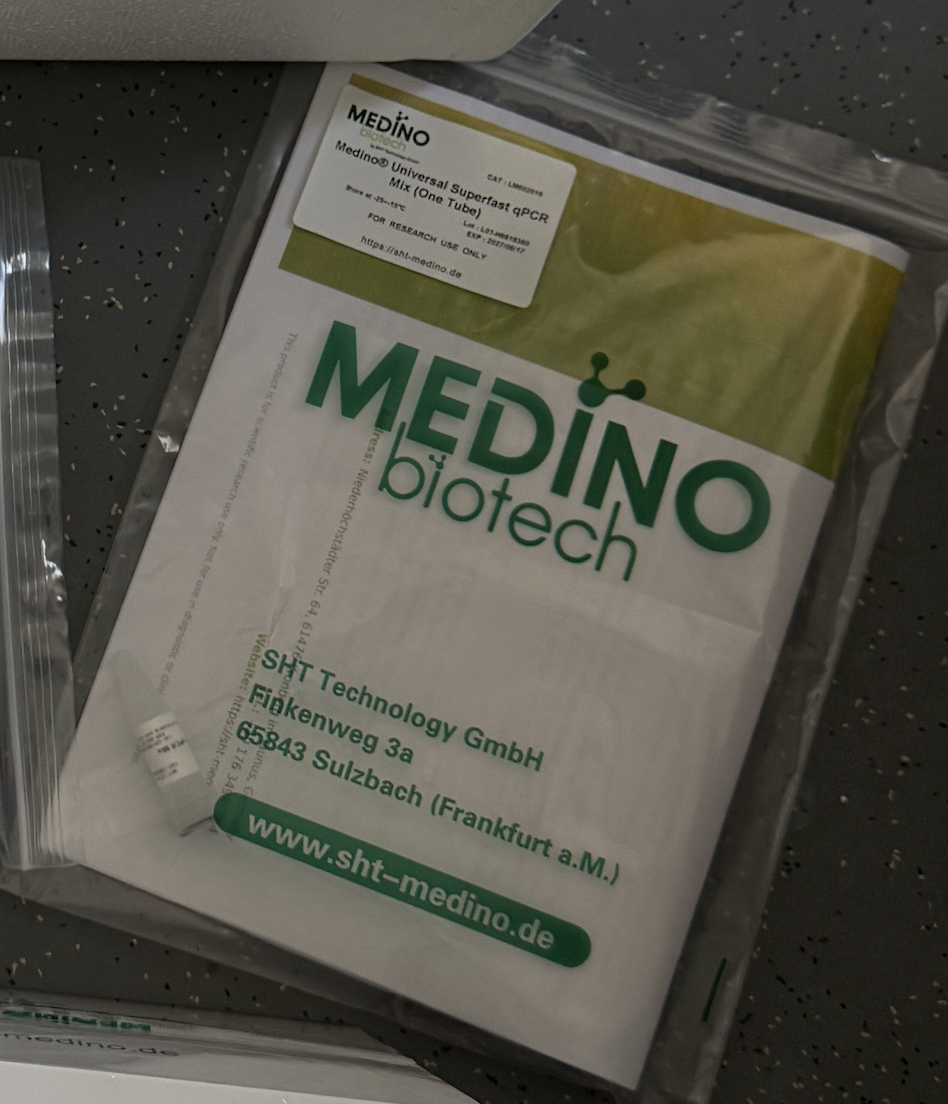
qNTQX® Universal Superfast qPCR Mix (One Tube), catalog no. LM602016, delivers qPCR results in approximately 20 minutes under the reported SLAN 48S fast-cycling conditions. The application study compares this with an approximately 50-minute standard run. This 2× probe-based DNA qPCR premix combines antibody-mediated hot-start Taq with dUTP/UDG carryover control and supports multiplex assays and advance primer/probe mixing. Amplification run time excludes sample preparation and setup and varies by instrument and assay. For research use only.
qPCR results in ~20 min
Complete a 40-cycle fast run in approximately 20 minutes on SLAN 48S under the reported test conditions.
~50 min to ~20 min
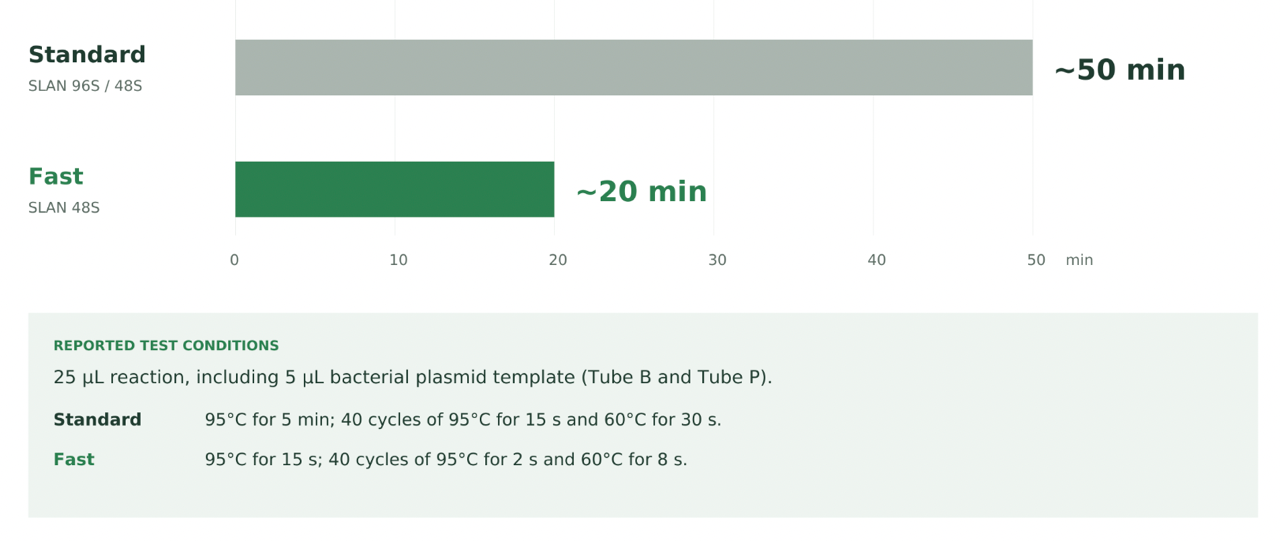
The application study reports approximately 50 minutes for standard cycling and 20 minutes for fast cycling. Times refer to amplification runs.
One-tube convenience
The 2× premix supports advance primer/probe mixing. Tested full premixes retained performance after 7 days at 37°C.
Specifications
| Parameter | Value |
|---|---|
| Product format | 2× qPCR premix; one tube |
| Detection chemistry | Probe-based DNA qPCR; multiplex compatible |
| Enzyme technology | Antibody-mediated hot-start Taq DNA polymerase |
| Carryover control | dUTP/UDG system |
| Recommended reaction volume | 25 or 50 µL |
| Mix per 25 µL reaction | 12.5 µL (1× final) |
| Compatible platforms (examples) | Bio-Rad CFX96; ABI QuantStudio 5 and 7500; SLAN 48S |
| Storage | −25 to −15°C |
| Shelf life | Up to 12 months |
| Intended use | Research use only |
Pack sizes & ordering
| Catalog No. | Nominal tests | 2× mix volume |
|---|---|---|
| LM602016ES01 | 100 | 1.25 mL |
| LM602016ES02 | 1,000 | 12.5 mL |
| LM602016ES03 | 10,000 | 125 mL |
One test (T) is a 25 µL reaction using 12.5 µL of 2× mix. State the required pack size when ordering. Source: LM602016 qNTQX® Universal Superfast qPCR Mix (One Tube) handbook, p. 2.
Performance & validation
qPCR results in approximately 20 minutes: the reported SLAN 48S fast programme reduces amplification run time from approximately 50 minutes with standard cycling to approximately 20 minutes with fast cycling. Tested with bacterial plasmid templates in 25 µL reactions, including 5 µL template. Times exclude sample preparation and setup and depend on the instrument and assay. Source: LM602016 handbook, pp. 4–5.
~20 min fast run
SLAN 48S: 95°C for 15 s, then 40 cycles of 95°C for 2 s and 60°C for 8 s.
~50 min standard run
SLAN 96S / 48S: 95°C for 5 min, then 40 cycles of 95°C for 15 s and 60°C for 30 s.
Tested reaction conditions
25 µL total volume, including 5 µL bacterial plasmid template (Tube B and Tube P). Reported times are approximate.
Product documents
Product FAQs
The SLAN 48S study used 95°C for 15 s, then 40 cycles of 95°C for 2 s and 60°C for 8 s. Run time excludes sample preparation and setup and varies by instrument and assay. It supports probe-based DNA qPCR, including multiplex assays. No reverse-transcription step is included. Convert RNA to cDNA first. Add target-specific primers, probes, DNA template and water. For 25 µL, use 12.5 µL of 2× mix and 1–10 µL template. Yes. Tested full premixes retained performance after 7 days at 37°C. Validate your own assay formulation. Store at −25 to −15°C for up to 12 months. The 37°C study does not establish routine room-temperature storage. dUTP/UDG helps reduce carryover from uracil-containing amplicons. The product is for research use only, not diagnostic or clinical procedures.How can I obtain qPCR results in approximately 20 minutes?
Is this a probe-based mix, and can it amplify RNA directly?
What do I add to the one-tube premix?
Can primers and probes be pre-mixed?
How should the reagent be stored?
Does it include carryover control, and is it for diagnostic use?