
Applications / Food safety analysis
Make food safety decisions with molecular confidence
Molecular biology detects the DNA or RNA signatures that reveal what is in a food sample—helping laboratories verify authenticity, identify pathogens and support reliable compliance decisions.
Food safety molecular analysis
From sample to confident detection

HOW IT WORKS
From sample to a defensible result
By targeting characteristic nucleic-acid sequences, molecular methods can achieve high specificity even in complex or processed foods. The appropriate assay and controls should always be selected for the sample matrix and intended use.
01 / SAMPLE
Collect & prepare
Food, environmental or process samples are homogenized and prepared to recover analyte reliably.
02 / EXTRACT
Isolate DNA / RNA
Purified nucleic acid is obtained while minimizing inhibitors from the food matrix.
03 / DETECT
Amplify & identify
PCR, qPCR, RT-PCR or sequencing targets a species-, organism- or event-specific sequence.
04 / INTERPRET
Quality-controlled result
Positive, negative and internal controls support clear reporting and downstream decisions.
Product categories
Solutions for the questions that matter
Explore product categories for routine screening, confirmatory testing and assay development workflows.
GMO Analysis
Screen and identify genetically modified material using common regulatory elements or event- specific targets.
Pathogen Detection
Rapidly screen for foodborne pathogens and relevant virulence targets across food and environmental samples.
Animal species identification
Verify declared animal species and support investigations of meat and seafood adulteration.
Allergen & authenticity
Support label verification and authenticity testing with targeted assays for high-risk ingredients.
Build your workflow
Products for food safety analysis
Select extraction, amplification and sampling components for dependable DNA/RNA-based food safety testing.
01 — DNA / RNA extraction
The bottleneck step, automated and matrix-ready
Extraction quality determines whether the amplification step can run. Medino’s magnetic-bead workflow supports demanding food matrices on two automated platforms sized to your laboratory’s daily sample volume.
Extraction instruments
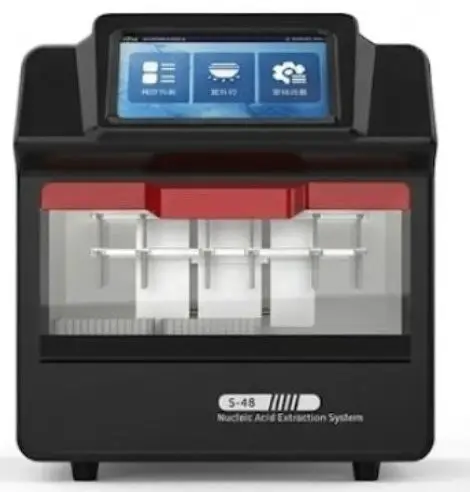
S-48 Nucleic Acid Extraction System
Benchtop 48-channel system for satellite laboratories and mid-volume QC lines that still need walk-away extraction.
Cat. S-48
48 channels
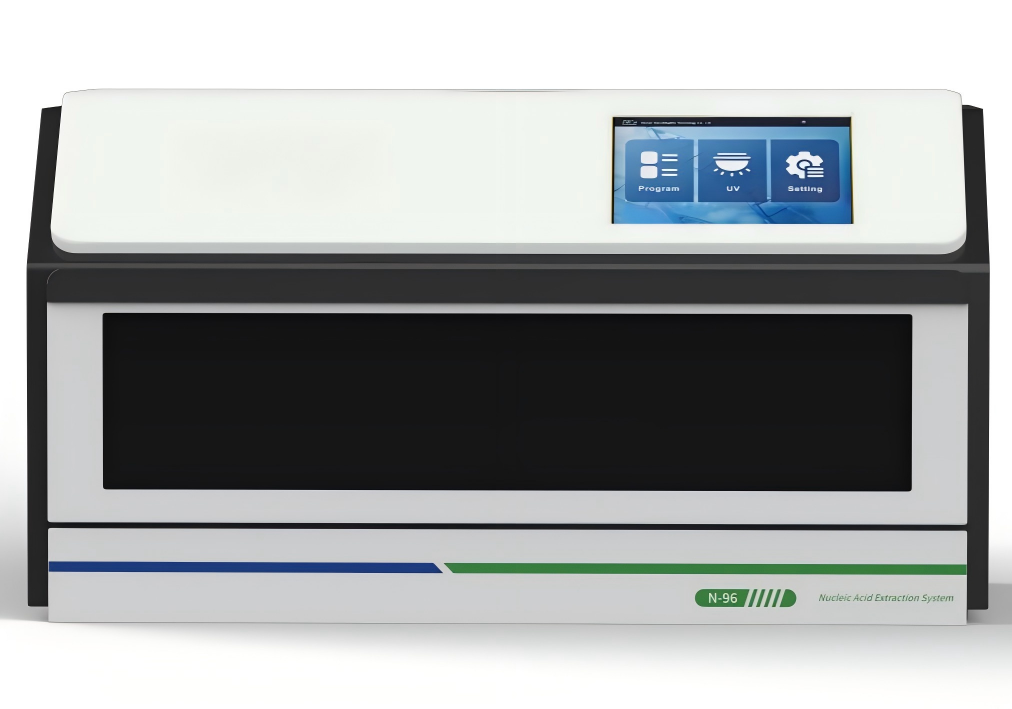
N-96 Fully Automated Nucleic Acid Extractor
96-channel walk-away platform for central-lab throughput-a full plate of samples extracted with one protocol and one operator touch.
Cat. N-96
96 channels
Pre-filled extraction kits (magnetic bead-based)
| Product | Cat. No. | Feature | Specification |
|---|---|---|---|
| NUCQX® Magnetic Bead-Based Tissue Genomic DNA Extraction Kit | LM102112 | Pre-filled Extraction Kits (Magnetic Bead-based) | 50 T/100 T/500 T |
| NUCQX® Magnetic Bead-Based Viral, Bacterial and Fungal Genomic DNA Extraction Kit | LM102110 | Pre-filled Extraction Kits (Magnetic Bead-based) | 16T – 500T |
| NUCQX® Universal Magnetic Bead-Based Plant DNA Extraction Kit | LM102111 | Pre-filled Extraction Kits (Magnetic Bead-based) | 50 T/100 T/500 T |
| NUCQX® Animal Virus Fast DNA/RNA Extraction Kit | LM102147 | Pre-filled Extraction Kits (Magnetic Bead-based) | 20/100 preps/kit (bottled) or 32 preps/box (pre-filled, 8 preps/plate × 4 plates) |
02 — qPCR master mix
Five chemistries, one decision: how the sample gets to you.
The right master mix depends less on the target than on the logistics around it—whether the reagent needs to survive a warm shipment, run in minutes on a crowded QC line, or resist carryover contamination.
| Product | Cat. No. | Feature | Specification |
|---|---|---|---|
| qNTQX® qPCR SYBR Green Master Mix (No Rox) | LM601003 | Hot-Start SYBR Green I, Melt-Curve Analysis | 5 × 1 ml/100 × 1 ml |
| qNTQX® Universal Superfast qPCR Mix (One Tube) | LM602016 | One-Tube Pre-Mixed | 100 T/1,000 T/10,000 T |
| qNTQX® Universal Multiplex qPCR Master Mix (Probe Based) | LM602002 | Universal (Probe Method) | 1 ml/5×1 ml/50×1 ml |
| qNTQX® Lyo-Ready I TaqMan Multiplex qPCR Mix | LM602011 | A lyophilizable reagent | 100 T/1,000 T |
| qNTQX® Lyo-Ready I TaqMan Multiplex qPCR Mix (Bead in Tubes) | LM602011-C | Lyophilized beads in PCR tubes | 16 T |
| qNTQX® Universal TaqMan Pro U+ qPCR Mix (One Tube) | LM203026 | Stability, dUTP / UDG | 100 T/1,000 T/10,000 T/15,000 T/20,000 T |
03 — LAMP
Isothermal amplification, built for a simpler path to an answer.
LAMP moves amplification beyond the thermocycler. By operating at a constant temperature, it gives laboratories a flexible option for rapid, targeted testing—whether the result is read through fluorescence or an easy visual colour change.
| Product | Cat. No. | Feature | Specification |
|---|---|---|---|
| ISOQX® LAMP Fluorescent Assay Kit (Bst Plus HSS) | LM701102 | Kit | 100 T/1,000 T |
| ISOQX® LAMP pH Sensitive Dyestuff Kit | LM701204 | Kit | 100 T/1,000 T/10,000 T |
04 — Consumables
The small details that keep a food-safety workflow moving.
Reliable molecular results depend on more than chemistry. From sample collection and enrichment through magnetic-bead separation, the right consumables protect sample integrity and keep every step compatible, clean and ready for throughput.
| Product | Cat. No. | Feature | Specification |
|---|---|---|---|
| ValliQ® Sterile Sampling Bags | ME101055 | collecting, storing, and transporting solid, semi-solid, and liquid samples. Temperature range of 220°C to 240°C. | various sizes |
| ValliQ® 96 Deep-Well Plates | ME10421 | Compatible Consumables for Instruments | 96 wells |
| ValliQ® 96-Well Magnetic Rod Tip Comb | ME10411 | Compatible Consumables for Instruments | 96 wells |
Why molecular testing
Specific evidence, faster insight
√ High analytical specificity through sequence-based targets
√ Suitable for routine screening and targeted confirmation
√ Supports traceability, quality assurance and compliance workflows
Important context
Interpret results with the sample in mind
Processing can degrade nucleic acids, and food matrices may inhibit amplification. A detected genetic signal does not automatically establish viability or risk. Robust methods therefore include appropriate sampling, extraction, controls and validation.